


Once you’ve seen the show, evaluate the program at Heyteachers.org.
After you complete the program evaluation you will be entered in a drawing for a chance to win $250 for your classroom.
TEACHER TOOLKIT
Goldenfields Water and NTC invite you to use these e-learning resources to teach your students about the importance of water literacy and conservation. The digital materials below are designed to get your students excited about understanding these important subjects.
Want to know the best way to use the related videos, e-books, games and other lessons to educate your class? Watch this short video and learn how to easily add Aqua Avengers to your curriculum.
EDUCATOR VIDEO
PROGRAM OVERVIEW
Our live in-school theatrical programs are a great way to educate students about a wide variety of topics. Theatre has the ability to capture imaginations and educate at the same time! This 30-minute performance features two engaging actors performing a fun story that keeps students laughing and learning.
Aqua Avengers teaches students the following educational points:
- Why water is important
- Water’s incredible journey
- Why we need to save water
- How you can protect water
During the performance, your students will learn important lessons about water conservation. You can use the lessons and activities on this page to prolong the engagement for months to come.
Educational Standards
We know your class time is extremely valuable. That’s why we ensure that all of our digital e-learning materials are aligned with curriculum standards. It’s important that the Aqua Avengers program complements your existing curriculum and helps students stay on track with their ongoing learning.
See below for details about how each digital activity aligns with educational standards and corresponds with your state’s curricula.
STUDENT ACTIVITIES
The Aqua Avengers student activities page features games, educational lessons, downloadable PDFs, e-books, Power Play games and more! Access in the classroom or at home to learn more about water conservation.
STUDENT BOOKLET
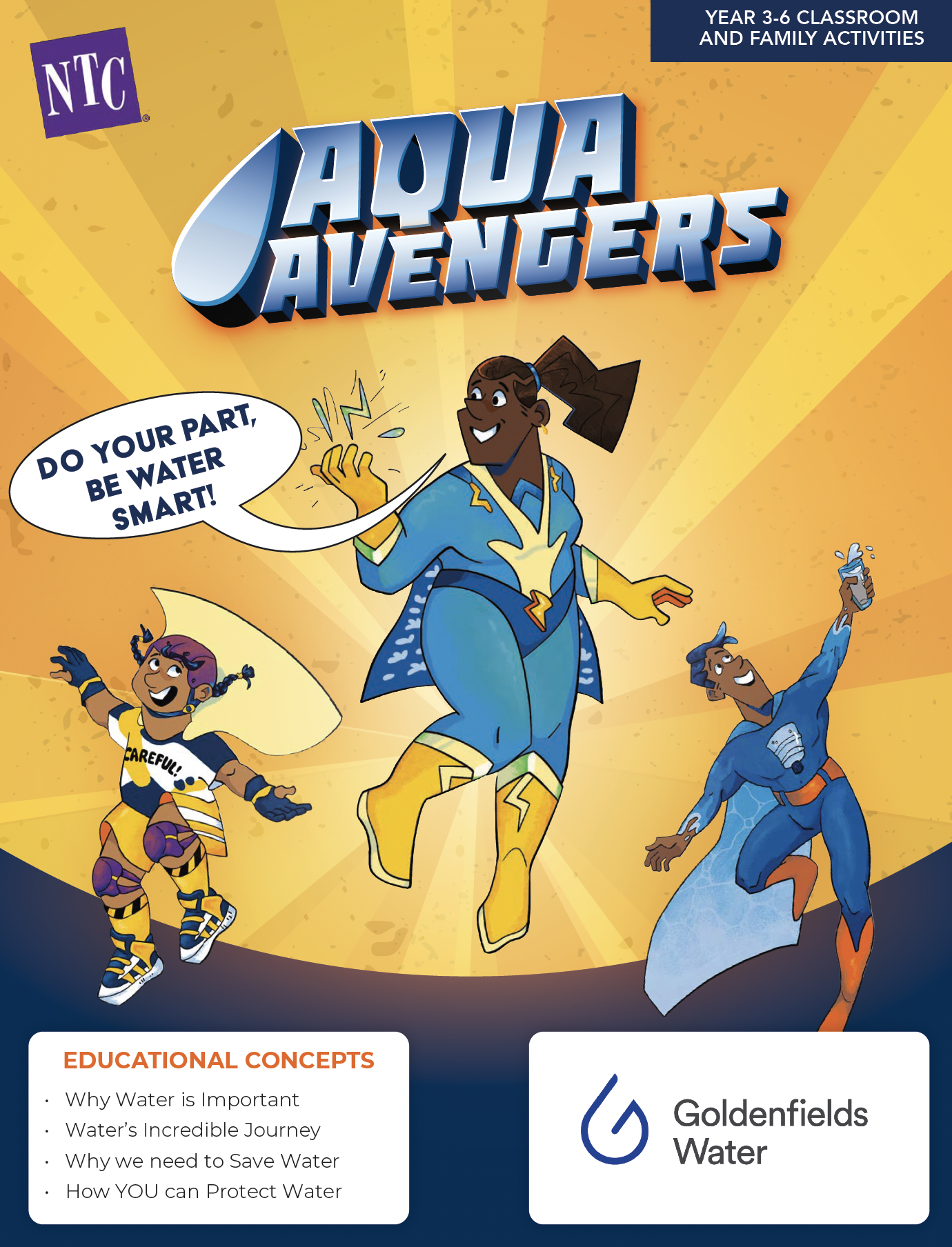
This downloadable PDF features colourful artwork, entertaining games and activities, and expanded information to complete your student’s understanding of water conservation. Read on your own, with your class or with friends and family and get to know the Aqua Avengers.
E-book
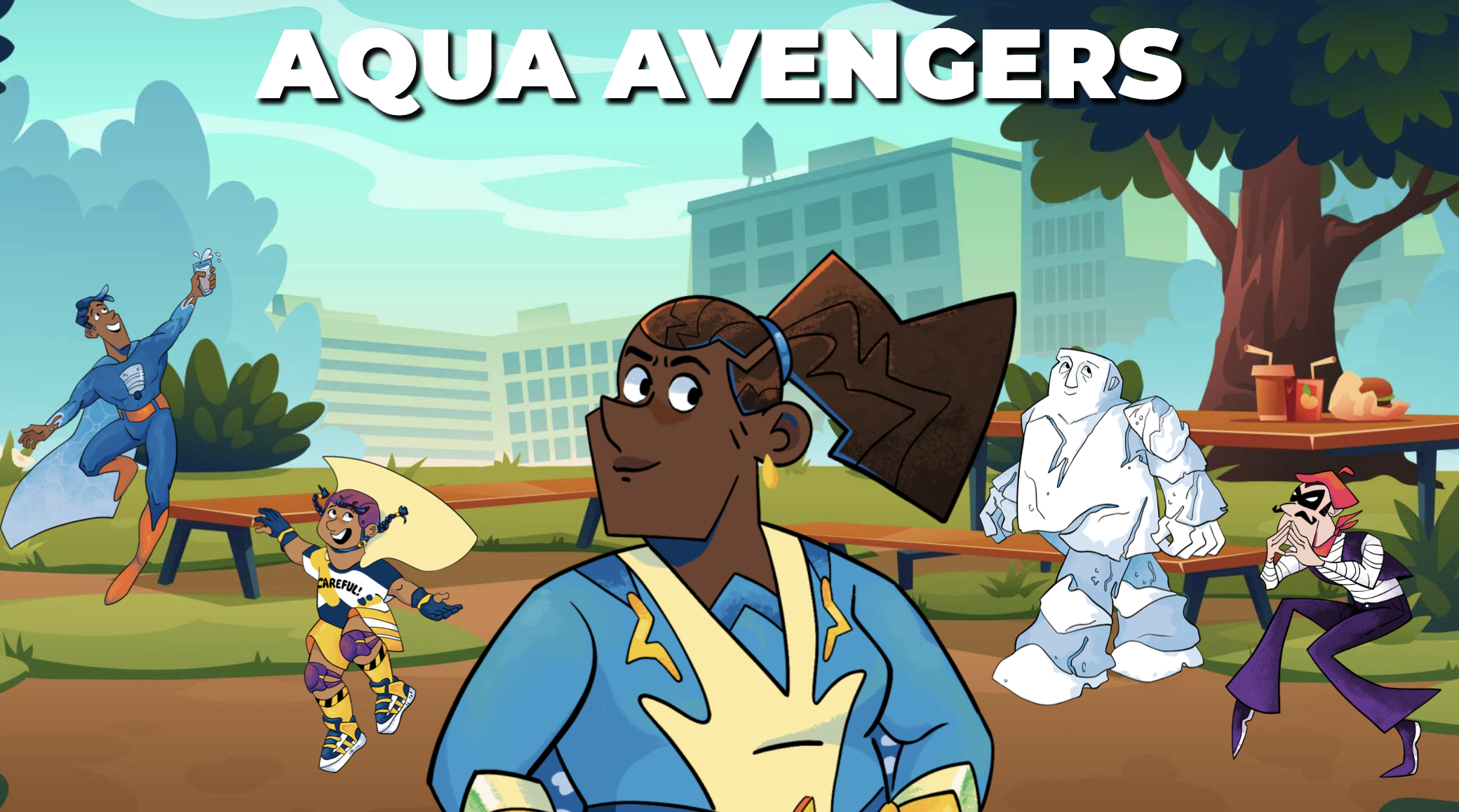
This colourful, illustrated e-book is a great follow-up to the live program. Students can read to themselves or with others, and younger students can use the read-aloud option. The e-book takes your students on a new adventure and includes fun interactive activities throughout.
Poster
HANDS-ON LESSONS
Your students can enhance what they learn from the program with these fun, hands-on lessons and experiments. These lessons can be done in the classroom or easily adapted for students to do at home with their families.
They’re a fun and educational way for students to learn with family members. The materials needed for these lessons are basic supplies that most people have at home. Follow up with your students to make sure they enjoyed and learned from these activities.
Lesson 1: The Water Cycle
Objective
Make a miniature environment to see the water cycle at work.
Purpose of Activity
Apply Skills, Create
21st Century Skills
Critical Thinking
Cognitive Level
Strategic and Extended Thinking
Class Time
45 minutes over three days
Materials
- Soil
- Water
- Small plastic bowl
- Large, clear plastic container or an old aquarium
- Plastic wrap
- Plastic trees, animals, boat, etc. (optional)
- Tape or large rubber band
- Bag of ice (optional)
- Heat lamp (optional)
Procedure
- Arrange the soil in the container to make mountains, plateaus, hills and a lake basin. Place the small bowl in the lake basin. Fill the bowl with water. Add any toy animals, trees or boats to the environment. Cover the container tightly with plastic wrap and secure it by means of tape or the band. Place the container near a sunny window.
- Discuss what is expected to happen in the container.
- Depending on the amount of sun, the project may take one to three days. In order to speed up the process, a bag of ice may be placed on one end of the covered container, while a heat lamp is focused on the other.
- Watch for condensation on the plastic wrap ‘sky’ of the container. When enough moisture collects, it will fall onto the landforms as precipitation.
Critical Thinking Questions
Where is water collecting?
- It is collecting on the inside of the plastic wrap cover.
Why is it collecting there?
- The water is evaporating and that is what is causing it to condense there.
What happens to the water after it evaporates?
- It precipitates back down into the aquarium.
Lesson 2: Water Treatment
Objective
Make a water filter that can treat raw water.
Purpose of Activity
Apply Skills, Create, Review
21st Century Skills
Critical Thinking, Collaboration
Cognitive Level
Strategic and Extended Thinking
Class Time
45 minutes
Materials
- One 2 Litre plastic bottle
- Fine sand
- Coarse sand
- Rocks (you can buy all of these items at a craft or pet store store, or you can collect them from nature)
- Coffee filter
- Anything else you think will help filter the water: fabric, cotton wool balls, a sponge
Procedure
- Wash your bottle, then cut it in half so the top with the lid is separated from the base. Take the cap off and place it face down inside the bottom half of your bottle.
- Fold a coffee filter in half several times so it forms a cone shape, open it and place it inside the bottle. You now have the start of your filter!
- Pour a layer of each of your materials, starting with the finest and working your way up to the coarsest. Your order might look something like this: fine sand, coarse sand, cotton wool balls (if you have them), small rocks, big rocks.
- Get a glass of clean water and a glass of water filled with dirt, twigs, and any other impurities you might find.
- Pour the clean water slowly into your filter and let it sit. Be patient, it will take a bit to get through all those layers. Observe what happens to the water.
- Once the water has filtered through, put it back into the glass. Now pour the dirty water into your filtration system and observe. Once it has made its way through the filter, compare the two samples and note their differences (DO NOT drink the water samples).
Critical Thinking Questions
What is the difference between the two samples after being treated?
- Answers will vary but should include discussion on the effectiveness of filtration and the visible impurities in the water.
What would you do differently if you had to remake your filter?
- Change the order of the layers, use new materials, pour more slowly
Does the water look safe to drink? What dangers could still be present, and how would you treat them?
- There could still be invisible contaminants like microorganisms and bacteria. These can be treated with a chemical disinfectant like chlorine, or with UV light (or by boiling if you were in an emergency situation).
Lesson 3: Water Management
Objective
Examine various methods of water use, and analyse their potential water waste to measure how much water gets wasted in various scenarios.
Purpose of Activity
Apply Criteria, Analyse, Review
21st Century Skills
Critical Thinking
Cognitive Level
Strategic and Extended Thinking
Class Time
45 minutes
Materials
- Writing materials
- The internet
Procedure
Part 1: Pairs of students choose one of the following water uses or another of their choosing:
- Dish washer
- Clothes washing machine
- Watering home garden beds
- Watering home lawn
- Cleaning cars at a car wash
- Propagating plants in a nursery
- Irrigation water for fruit crops
- Irrigation water for cotton crops
- Irrigation water for rice
- Irrigation water for grass and clover on a dairy farm
- Water for operating a coal fired power station.
Part 2: Ask each pair of students to research the area of water use that they have chosen from above and develop a set of criteria that can be used to judge the amount of water that is being used and how much of it is being wasted.
The following are some prompts that the students may use to start thinking about their criteria for judging the use of water resources:
- Economic impacts
- Examples of best use
- Other alternatives
- Competition for water resources
- Wasting water
- Water treatment after use
- Impact of waste water on the environment and health
- Impact of using and disposing of water on the catchment.
Closing activities As a class present your research and discuss the criteria for different water uses.
Critical Thinking Questions
Did any of the pairs have criteria in common?
- Could that criteria be applied to other areas of water management?
Can the different water uses be grouped and assessed under the same criteria?
- If not, what are the differences between them?
If students had to put all their chosen water uses on a scale from least to most water efficient, what would that look like?
Lesson 4: Global Systems
Objective
Understand the interconnectedness of Earth’s major systems (Atmosphere, Lithosphere, Hydrosphere, and Biosphere) and analyse the impacts of disruptions in these systems.
Purpose of Activity
Apply Concepts, Analyse Interactions, Review System Balance
21st Century Skills
Critical Thinking, Systems Thinking
Cognitive Level
Strategic and Extended Thinking
Class Time
45 minutes
Materials
- Writing materials
- Large paper or whiteboard
- Markers
- Access to the internet or science textbooks
Procedure
Part 1: Introduction to Global Systems (15 minutes)
Teacher Presentation:
Begin with a brief overview of Earth’s major systems: Atmosphere, Lithosphere, Hydrosphere, and Biosphere.
Discuss how these systems interact with each other by exchanging energy and matter.
Explain the importance of maintaining balance within and among these systems, and how disruptions can lead to environmental issues like climate change.
Class Discussion:
Engage students by asking them to provide examples of how these systems interact in daily life (e.g., water cycle, plant growth, weather patterns).
Record key points from the discussion on a whiteboard or large paper.
Part 2: Analysing System Interactions (20 minutes)
Group Activity:
Divide the class into four groups, assigning each group one of the four systems (Atmosphere, Lithosphere, Hydrosphere, Biosphere).
Each group will research their assigned system, focusing on its key components, how it interacts with the other systems, and what could happen if it is disrupted.
Students should use the internet or textbooks to gather information, and create a visual representation (e.g., diagram, flowchart) of their system and its interactions.
Class Presentation:
Each group will present their findings to the class, explaining how their system interacts with the others and what happens when there is an imbalance.
Encourage other students to ask questions and add to the discussion.
Part 3: Reflection and Conclusion (10 minutes)
Class Discussion:
Lead a discussion on the importance of maintaining balance within Earth’s systems.
Ask students to consider real-world examples where this balance has been disrupted (e.g., deforestation, greenhouse gas emissions) and discuss potential solutions to restore balance.
Closing activities
Have students write a brief reflection on what they learned about global systems, their interactions, and the importance of balance. They should also note one action they can take in their daily lives to help maintain this balance.
This lesson plan emphasises understanding the interconnectedness of Earth’s systems, encouraging students to think critically about the balance required to maintain environmental stability. It combines research, collaboration, and reflection to deepen students’ comprehension of global systems and their significance.
Critical Thinking Questions
1. Interconnectedness and Impact:
Question: “How does a change in one of Earth’s systems, such as an increase in carbon dioxide levels in the atmosphere, affect the other systems (Lithosphere, Hydrosphere, and Biosphere)? Provide specific examples to illustrate these impacts.”
- Purpose: This question encourages students to think deeply about the ripple effects that occur across Earth’s systems when there is a disruption in one of them, promoting an understanding of interconnectedness.
2. Human Influence on Global Systems:
Question: “In what ways do human activities contribute to imbalances in Earth’s systems, and what are some strategies we can implement to restore balance? Consider activities such as deforestation, industrial agriculture, and fossil fuel consumption.”
- Purpose: This question prompts students to critically analyse the role of human activities in disrupting natural systems and to explore potential solutions for mitigating these impacts.
3. Sustainable Management of Earth’s Systems:
Question: “Given the interconnected nature of Earth’s systems, what sustainable practices can be implemented in agriculture, urban development, and energy production to ensure that all systems remain balanced? How do these practices benefit both the environment and human society?”
- Purpose: This question extends learning by challenging students to apply their knowledge of global systems to real-world practices, emphasising the importance of sustainability in maintaining balance across Earth’s systems.
EXPANDED INFORMATION & ADDITIONAL RESOURCES
You’ve covered the basics of water conservation. If you really want to dig deep with your class, explore the expanded information and additional resources below.
These materials provide even more insight into the history, science, usage and importance of water conservation. There are also helpful links and tips.
Expanded Information 1: Water Fun Facts
WATER FUN FACTS
Ninety-seven percent of the Earth’s water is salt water in the ocean. Two percent is stored as freshwater in glaciers, and there’s also some deep underground. This leaves approximately 1% of all the water on Earth as water for people to use. If all the world’s water were put into a litre jug, the fresh water available for us to use would equal to a single large drop of water.
HOW MUCH WATER ARE YOU?
Students will calculate how many glasses of water they are made of. (An average glass is around 236ml)
Have students write down their approximate weight.
Divide their weight by three.
Multiply the new number by four.
That’s about how many glasses of water it would take to equal all the water in a person.
The human body consists of up to 60% water. By the time a person feels thirsty, their body has lost over 1% of their total water amount. Make sure you drink water before you get thirsty!
Facts:
- Each day the sun evaporates one trillion tons of water off of lakes, rivers and oceans.
- Over 25,000 litres of water is needed to grow a day’s food for a family of four.
- Flying by plane from Adelaide to Sydney uses up around 4000 litres of water for every passenger.
- There is exactly the same amount of water on Earth now as there was in prehistoric times.
- Water is the only substance on Earth naturally found in the three true element forms: solid, liquid and gas.
- Water expands by 9% when it freezes. Ice is lighter than water, which is why ice floats on water.
Expanded Information 2: Where does my water come from? - Science
THE WATER TREATMENT PROCESS
Raw water is full of all kinds of contaminants and impurities that make it harmful for humans to drink. This includes obvious things like sticks, plant matter, and rubbish – but also all the invisible nasties like microorganisms, which include parasites and bacteria that can be harmful for human health. Before it can be delivered to our taps it needs to go through a rigorous treatment process to make sure it’s completely safe to drink. Most treatment plants around the world use four main processes to treat raw water.
Stage 1: Coagulation
A chemical (coagulant) is added to the water that traps all of the impurities and makes them clump together forming ‘flocs’.
Stage 2: Sedimentation
The water is left to sit until the flocs sink down forming a ‘sludge’ on the bottom. The clear water on top moves on and the sludge can be re-used for soil conditioning.
Stage 3: Filtration
Any remaining solids are removed by passing through compact layers of gravel, sand and anthracite (a mineral sometimes referred to as ‘hard coal’). Each level of grit gets finer and finer, ending in a very fine synthetic membrane.
Stage 4: Disinfection
A small amount of disinfectant (usually chlorine) is added to inactivate any microorganisms. Another method is to blast the water with ultraviolet (UV) light.
Expanded Information 3: Where does my water come from? - Geography
WHERE DOES MY WATER COME FROM?
If you live in an Australian city, there’s a good chance that your water comes from surface water such as streams, rivers and reservoirs filled by rainfall and runoff. This water is collected, treated and delivered by one of the many water treatment facilities around the country. Just like the Jugiong Treatment Plant, which treats between 12 to 18 megalitres of water every day, providing quality drinking water to approximately 18,000 people from various regions of NSW.
But in a lot of areas in Australia, groundwater is the primary source of water – sustaining whole towns, farms, mines and irrigation networks.
The Great Artesian Basin (GAB) is Australia’s largest underground freshwater system, and one of the deepest and most impressive in the world!
Extending more than 1.7 million square kilometres, the GAB sits underneath 4 different states and territories, they are Queensland, New South Wales, South Australia and the Northern Territory. Estimated at 64,900 million megalitres, the GAB contains a HUGE amount of underground water. It’s a vital resource for town water supplies, agriculture, and industry.
Source: https://www.ga.gov.au/scientific-topics/water/groundwater/gab
Expanded Information 4: Climate Change
One of the biggest threats to water security is climate change. There are many ways that climate change is having an impact on water supplies around the world, the main contributor being rising global temperatures. The water cycle supports the global ecosystem, and climate change sets off a chain of events which have serious outcomes.
- Hotter temperatures mean more water is evaporated into the air.
- More water vapour in the air causes much heavier rain.
- Extreme rainfall results in more floods, where more water falls than vegetation and soil can absorb.
- The runoff from floods drains into waterways but can pick up contaminants like fertiliser and waste on the way.
- Excess water eventually travels to larger bodies of water like lakes or oceans, polluting the water, if contaminated.
- When fertilisers enter the ocean it creates the rapid growth of algae.
- The resulting algal blooms block sunlight from reaching underwater life
- Less sunlight means lower oxygen levels in the water
- Toxins from the blooms can kill off fish and other aquatic life and be harmful to humans
- These toxins can survive the water treatment process meaning water can’t be drunk once contaminated
The domino effect doesn’t stop here, with long term follow-on effects being rising sea levels and melting ice caps. It can be sobering to think about the bigger picture of climate change – but there are countless actions we can take to support our water security and combat the negative effects of a warming planet:
- Grow your own fruits and vegetables or buy locally grown
- Opt for a walk or bike ride over the car wherever possible
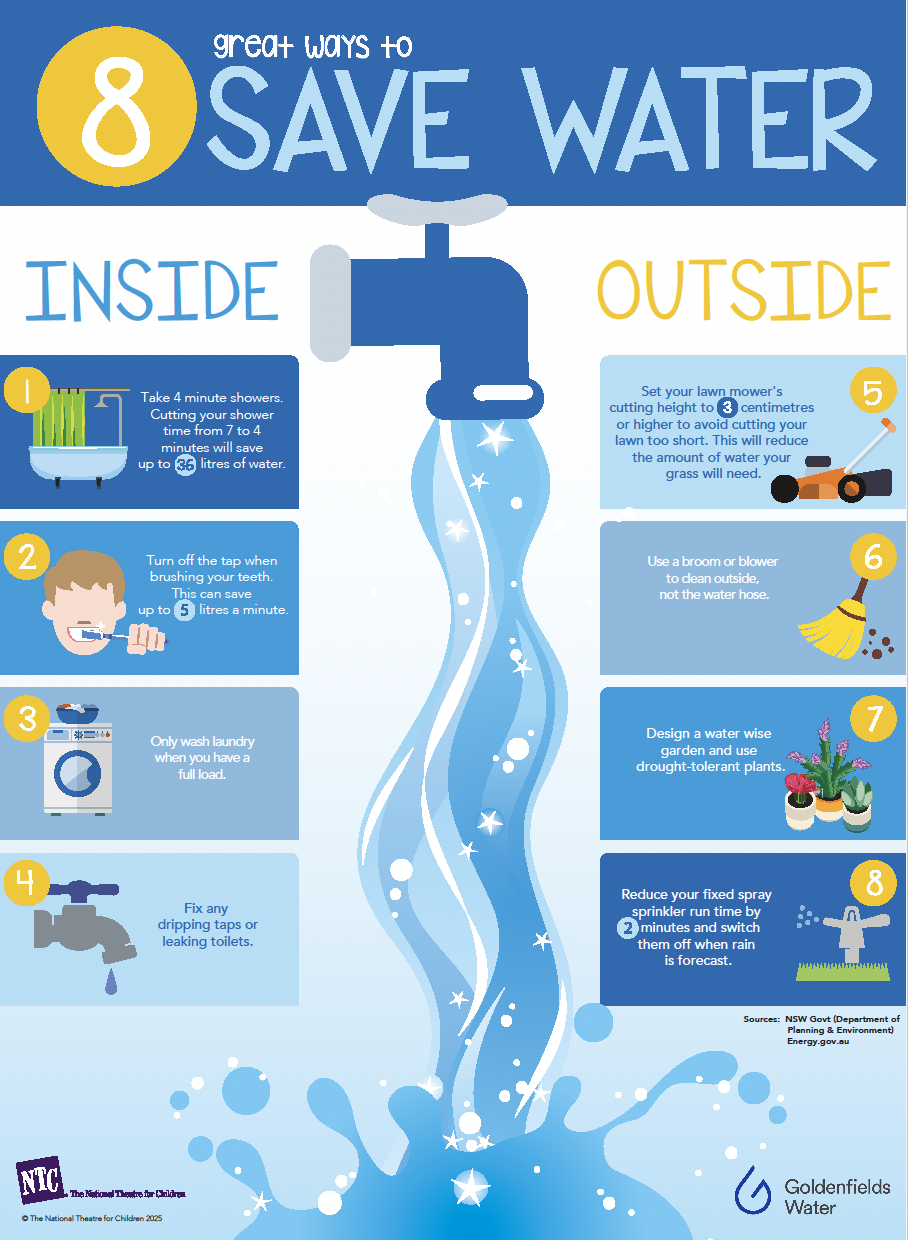
- Use water saving measures like shorter showers or using rainwater
- Take a reusable water bottle with you instead of buying plastic bottles
- Turn off the tap whilst brushing your teeth
- Only use the washing machine and dishwasher when full
- Fix leaking taps & toilets
- Wash your car or bike with a bucket and sponge rather than the hose
The future of our water is in our hands and we have the power to protect our water and our planet.
Source: https://www.nationalgeographic.org/article/how-climate-change-impacts-water-access/
Expanded Information 5: Land Management
You might have heard of Water Sensitive Urban Design (WSUD) and its benefits to our community and water security, but what exactly does it mean, and what does it look like?
Words like bioretention, rain gardens and porous surfaces might sound familiar – let’s have a closer look at how they play a part in WSUD.
In natural environments (as opposed to the urban architecture of towns and cities) most rainwater has access to exposed earth or vegetation. This means when it rains, water is able to be absorbed into the ground, feed plants, or easily evaporate back into the atmosphere and return to the natural water cycle.
In human-made environments there is a lot more concrete, roads, roofs and paved areas that block the rain’s access to the ground. These surfaces are known as ‘impermeable’ meaning they stop the water from being able to reach the earth and be reabsorbed. This water is then forced to flow into sewers and waterways, becoming what is called ‘stormwater runoff’.
But can’t that runoff just be collected and treated? Unfortunately, because of all the cars and industry in urbanised areas, pollutants collect on the impermeable surfaces and are then picked up by the stormwater runoff, contaminating it. On top of that, there is excess stormwater, creating a higher chance of the water making its way into our rivers and creeks, contaminating our natural waterways. This can be a huge problem.
So what can we do? Aren’t all the cities and towns already built and can’t be changed?
WSUD uses small but effective modifications to capture and treat this stormwater closer to the surface before it can compromise our natural waterways. This doesn’t mean pulling up all the roads, but could include some of these methods:
- Rain gardens that utilise and collect the water close to the source
- Rainwater tanks in community spaces
- More street trees and native plants in public spaces
- Permeable pavements whenever new walkways are constructed
- Stormwater collection on industrial roof tops.
All of these methods (and more!) could work together to reduce the quantity of stormwater runoff, while improving its quality. It also protects and restores natural waterways, improves habitat for native wildlife, improves the appearance of our built areas, and also cools our environment by retaining more water.
See what you can do to help, and learn more about WSUD today: https://waterbydesign.com.au/wsud
Expanded Information 6: The Carbon Cycle
The Carbon Cycle is a fundamental concept in Earth and environmental science, illustrating how carbon is continuously recycled and exchanged among Earth’s atmosphere, oceans, soil, and living organisms. Understanding the Carbon Cycle is crucial for students, especially in the context of climate change and environmental sustainability.
To further explore the Carbon Cycle with students, consider discussing the following advanced topics:
- Carbon Sequestration: This refers to the long-term storage of carbon in plants, soils, geologic formations, and the ocean. Explore current and potential technologies for carbon capture and storage (CCS) and how they might mitigate climate change.
- The Role of Oceans in Carbon Storage: Discuss how the ocean acts as a carbon sink and the potential consequences of ocean acidification, which occurs when excess CO2 dissolves in seawater, lowering the pH and affecting marine life.
- Climate Change and Carbon Feedback Loops: Introduce the concept of feedback loops in the Carbon Cycle, where warming temperatures can lead to the release of more CO2 (e.g., from melting permafrost), further accelerating climate change.
Extended Classroom Activities and Discussions:
Model the Carbon Cycle: Have students create a physical or digital model of the Carbon Cycle, showing how carbon moves through the different spheres of the Earth (atmosphere, hydrosphere, lithosphere, biosphere).
Debate on Climate Solutions: Organise a classroom debate on the effectiveness of different strategies for reducing atmospheric CO2 levels, such as renewable energy, carbon taxes, reforestation, and carbon capture technologies.
Case Study Analysis: Use real-world case studies to explore the impact of carbon cycle disruptions on ecosystems, such as the Great Barrier Reef, and discuss possible conservation efforts.
ADDITIONAL LINKS
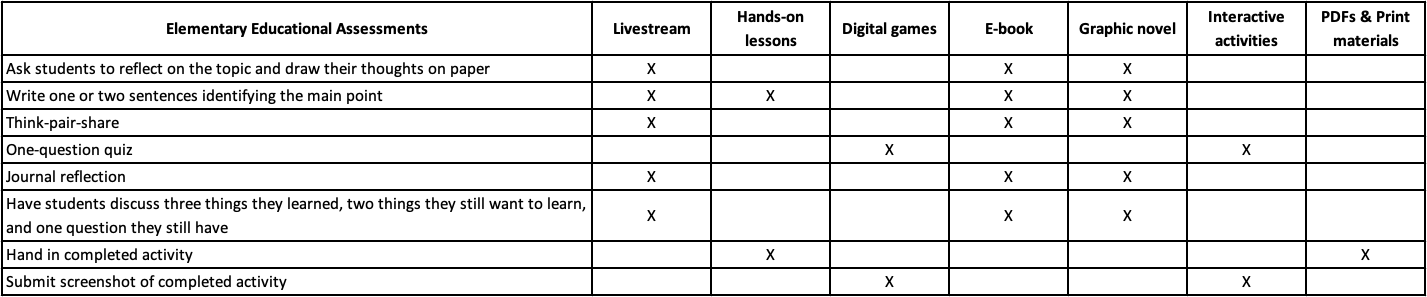
EDUCATOR ASSESSMENTS
Follow-up formative assessments are especially important for gauging your students’ learning in e-learning environments. Below are some suggestions for assessing your students’ performance quickly and effectively.
These assessments are easy for you and your students to complete, helping ensure your class receives the maximum educational value, retention, and engagement from the related digital activities.
EVALUATION
We take your feedback and suggestions very seriously. Hearing from educators with firsthand experience with our programs ensures that we continue to improve our digital resources, making them as beneficial as possible for you and your students.
Please complete this brief, two-minute evaluation to let us know what you thought.
Thank you for your time and valuable input.